

A brand new Google quantum report has highlighted new quantum vulnerabilities for Bitcoin, Ethereum, and different networks. The report additionally highlighted efforts by the XRP Ledger (XRPL), which might assist guard towards these quantum threats.
Google Quantum Report Acknowledges XRP Ledger’s Efforts
In its newest quantum crypto whitepaper, Google famous that the XRP Ledger and different networks, comparable to Solana, have made early experimental deployments of post-quantum protocols in a bid to obtain post-quantum safety for crypto property.
The Google quantum report additional highlighted how the XRPL not too long ago deployed post-quantum ML-DSA signatures on the testnet as a part of the efforts to sort out these vulnerabilities. This comes simply as Ripple revealed efforts to boost the XRPL’s security, together with integrating AI throughout the event cycle.
The report famous that blockchain networks comparable to Ethereum, Solana, TRON, and the XRP Ledger make long-term publicity of quantum-vulnerable public keys inevitable. However, Google steered that TRON and XRPL can higher deal with this vulnerability as they assist native, protocol-level key rotation. Modern Ethereum and Solana accounts assist key rotation, however legacy accounts stay in danger.
Bitcoin At Risk Of An On-Spend Attack
The Google quantum report famous that the Bitcoin community is now at larger threat of an on-spend assault due to advances in quantum expertise. In a blog post, Google Research said that it estimates two quantum circuits implementing Shor’s algorithm for ECDLP-256 (256-bit elliptic curve discrete logarithm drawback) could be executed on “a superconducting qubit CRQC with fewer than 500,000 physical qubits in a few minutes.”
They famous that that is round a 20x discount within the variety of bodily qubits {that a} quantum laptop requires to resolve ECDLP-25. The ECDLP-256 is what top-layer 1 networks comparable to Bitcoin depend on for vital elements of their safety.
In Bitcoin’s case, it’s prone to an on-spend assault, as the common block time is 10 minutes. Meanwhile, the Google quantum report estimates that it might take 9 minutes for a superconducting qubit CRQC (cryptographically related quantum laptop) to derive non-public keys from public keys within the mempool after which forge a transaction, thereby stealing the BTC.
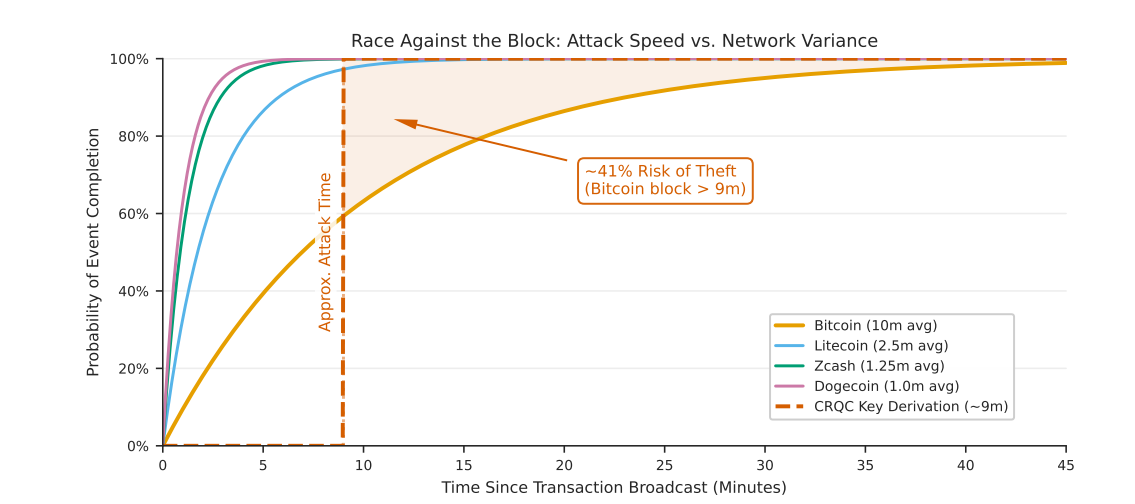
Google presently estimates a 41% success price underneath probably the most idealized assumptions. This would contain the attacker artificially creating community congestion by probably providing larger charges to miners, giving them sufficient time to receive the non-public keys and have their cast transactions frontrun the unique spender.
Ethereum Faces A Different Kind Of Quantum Threat
The Google quantum report famous that Ethereum’s quantum safety posture could be very completely different from Bitcoin’s, as the previous has a mean block time of 12 seconds, and most transactions are processed in lower than a minute. As such, it’s unlikely for the community to face an on-spend assault.
However, the report famous that the principle quantum risk towards Ethereum lies in numerous at-rest assaults. It is value noting that Ethereum’s co-founder, Vitalik Buterin, had previously mapped quantum risks to the community, highlighting 4 areas of vulnerabilities, together with consensus-layer BLS signatures.
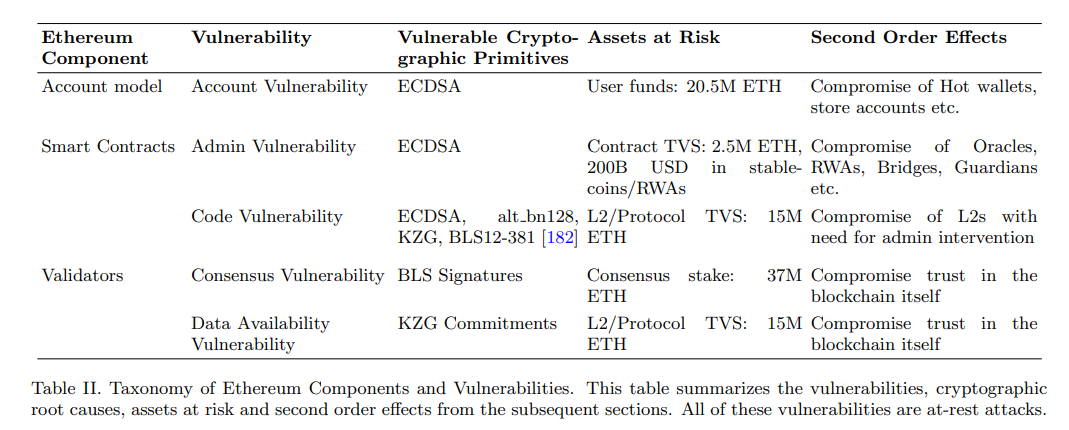
Google said that Ethereum has three outstanding options that differentiate it from Bitcoin, and that these additionally give it 5 forms of quantum vulnerabilities. These options embrace the account mannequin, sensible contracts, and validators, which create vulnerabilities in account, admin, code, consensus, and knowledge availability.
Google not too long ago shifted the quantum risk timeline to 2029, aiming to transition to post-quantum cryptography (PQC) by then. The analysis report famous that migrating these networks to PQC includes many complexities, however that networks such because the XRP Ledger have proven that it’s potential.