
- Bitcoin’s 2025 cycle exhibits rising institutional flows, decrease volatility, and deeper liquidity.
- Tokenized real-world property surge to $24 billion, boosting institutional adoption and on-chain activity.
- ETFs reshape Bitcoin liquidity as stablecoins stay key rails in a extra mature digital asset market.
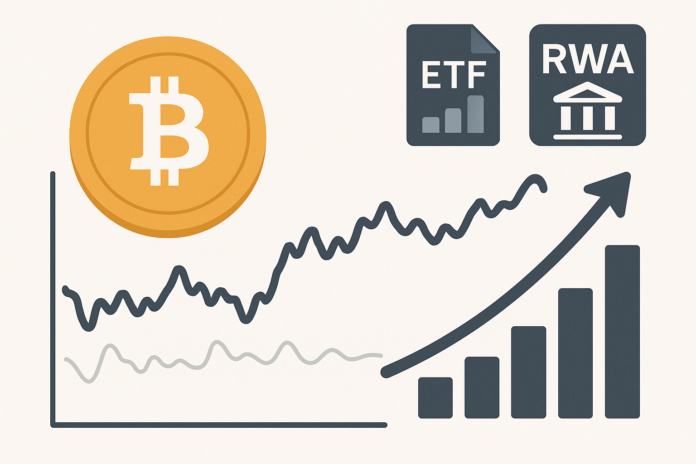
Bitcoin’s newest cycle is growing underneath a really completely different market construction, with information from Glassnode and Fasanara Capital pointing to deeper institutional participation, speedy progress in tokenized real-world property, and a notable drop in volatility.
Their Q4 Digital Assets Report highlights how Bitcoin’s behaviour has shifted as regulated funding channels increase, and liquidity turns into extra steady throughout spot, derivatives, and on-chain markets.
The findings present how ETF flows, settlement activity, and broader adoption of tokenised devices are shaping a extra mature part within the digital asset ecosystem.
These structural modifications are defining how capital strikes by Bitcoin in 2025.
Institutional flows reshape the cycle
The report estimated that Bitcoin has absorbed round $732 billion in new capital throughout this cycle.
This has occurred alongside a transparent decline in one-year realised volatility, which has fallen by almost half.
Glassnode linked this development to elevated depth throughout main markets and a bigger share of buying and selling pushed by institutional methods.
Glassnode additionally reported that Bitcoin settled roughly $6.9 trillion over the previous 90 days.
This places Bitcoin in a variety corresponding to cost networks comparable to Visa and Mastercard.
Even with extra buying and selling transferring into ETF and brokerage channels, the report discovered that Bitcoin and stablecoins nonetheless dominate worth switch on public blockchains.
ETF channels deepen liquidity
ETF-linked demand has reshaped how funding enters and exits Bitcoin.
Instead of relying primarily on on-chain motion or change activity, a better share of flows now passes by regulated funding autos.
According to the report, this shift has inspired smoother liquidity situations and fewer sharp worth modifications in spot markets.
Traditional market makers and arbitrage corporations have elevated their presence attributable to ETF participation.
Their involvement has tightened spreads and diminished disruption in periods of heightened promoting stress.
This growth displays a broader alignment between digital asset markets and established monetary infrastructure.
Tokenized RWAs speed up
Tokenized real-world property have expanded from $7 billion to $24 billion inside one 12 months.
Glassnode acknowledged that this rise displays stronger institutional demand, together with curiosity from pension funds, hedge funds, and companies that need on-chain publicity to acquainted monetary devices.
Tokenized funds have gained momentum as asset managers check new distribution fashions and buyers search simplified entry to conventional property.
Platforms concerned in tokenised RWAs have strengthened custody, settlement, and compliance techniques.
This basis has inspired constant inflows all through 2025, supporting a growing phase of the market that hyperlinks conventional property with blockchain settlement rails.
Stablecoin function strengthens
Glassnode described the market construction as bigger and extra steady than in earlier cycles.
The information indicated deeper liquidity throughout spot, derivatives, and on-chain channels, which has contributed to a extra measured buying and selling atmosphere.
Reduced volatility has turn into a defining characteristic of the cycle, formed by institutional buying and selling methods that have a tendency to make use of regular allocation fashions.
Stablecoins proceed to function key connectors between conventional and digital monetary techniques.
The report acknowledged that stablecoin settlement demand stays substantial throughout centralised and decentralised platforms.
Glassnode characterised the dual-rail system created by stablecoins and conventional infrastructure as a everlasting a part of the ecosystem, supporting each institutional flows and retail buying and selling activity.
Analysts referenced within the report anticipate institutional participation to increase as tokenised funds achieve broader acceptance.
Glassnode offered this part as a turning level marked by heavier institutional flows, rising tokenisation, and diminished volatility.
These elements recommend that Bitcoin and the broader digital asset sector are transferring right into a extra structurally mature atmosphere in 2025.