

Ethereum-focused treasury firm ETHZilla stated it has bought roughly $40 million price of ether to fund ongoing share repurchases, a maneuver geared toward closing what it calls a “significant discount to NAV.” In a press assertion on Monday, the corporate disclosed that since Friday, October 24, it has purchased again about 600,000 frequent shares for about $12 million below a broader authorization of as much as $250 million, and that it intends to proceed shopping for whereas the {discount} persists.
ETHZilla Dumps ETH For BuyBacks
The firm framed the buybacks as balance-sheet arbitrage moderately than a strategic retreat from its core Ethereum publicity. “We are leveraging the strength of our balance sheet, including reducing our ETH holdings, to execute share repurchases,” chairman and CEO McAndrew Rudisill stated, including that ETH gross sales are getting used as “cash” whereas frequent shares commerce under internet asset worth. He argued the transactions could be instantly accretive to remaining shareholders.
Related Reading
ETHZilla amplified the message on X, saying it might “use its strong balance sheet to support shareholders through buybacks, reduce shares available for short borrow, [and] drive up NAV per share” and reiterating that it nonetheless holds “~$400 million of ETH” on the steadiness sheet and carries “no net debt.” The firm additionally cited “recent, concentrated short selling” as an element protecting the inventory below strain.
The market-structure logic is easy: when a digital-asset treasury trades under the worth of its coin holdings and money, shopping for again inventory with “coin-cash” can, in concept, collapse the {discount} and carry NAV per share. But the optics are contentious inside crypto as a result of the mechanism requires promoting the underlying asset—right here, ETH—to buy fairness, probably weakening the very treasury backing that traders initially sought.
Death Spiral Incoming?
Popular crypto dealer SalsaTekila (@SalsaTekila) commented on X: “This is extremely bearish, especially if it invites similar behavior. ETH treasuries are not Saylor; they haven’t shown diamond-hand will. If treasury companies start dumping the coin to buy shares, it’s a death spiral setup.”
Skeptics additionally zeroed in on funding decisions. “I am mostly curious why the company chose to sell ETH and not use the $569m in cash they had on the balance sheet last month,” one other analyst Dan Smith wrote, noting ETHZilla had simply stated it nonetheless holds about $400 million of ETH and thus didn’t deploy it on contemporary ETH accumulation. “Why not just use cash?” The query cuts to the core of treasury signaling: utilizing ETH as a liquidity reservoir to defend a reduced fairness might be learn as rational capital allocation, or as capitulation that undermines the ETH-as-reserve narrative.
Beyond the buyback, a retail-driven storyline has quickly shaped across the inventory. Business Insider reported that Dimitri Semenikhin—who not too long ago turned the face of the Beyond Meat surge—has focused ETHZilla, saying he bought roughly 2% of the corporate at what he views as a 50% {discount} to modified NAV. He has argued that the market is misreading ETHZilla’s steadiness sheet as a result of it nonetheless displays legacy biotech outcomes moderately than the present digital-asset treasury mannequin.
Related Reading
The identical report cites liquid holdings on the order of 102,300 ETH and roughly $560 million in money, translating to about $62 per share in liquid belongings, and calls out a 1-for-10 reverse cut up on October 15 that, in his view, muddied the optics for retail. Semenikhin flagged November 13 as a possible catalyst if outcomes present the pivot to ETH producing income.
The firm’s personal messaging emphasizes the discount-to-NAV lens moderately than a change in technique. ETHZilla instructed traders it might maintain shopping for whereas the inventory trades under asset worth and highlighted a aim of shrinking lendable provide to blunt short-selling strain.
For Ethereum markets, the fast move impact is restricted—$40 million is marginal in ETH’s every day liquidity—however the second-order threat flagged by merchants is behavioral contagion. If different ETH-heavy treasuries observe the playbook, promoting the underlying to purchase their very own inventory, the move might grow to be pro-cyclical: cash are bought to shut fairness reductions, the promoting pressures spot, and wider reductions reappear as fairness screens rerate to the weaker mark—repeat.
That is the “death spiral” situation skeptics warn about when the treasury asset doubles as the corporate’s sign of conviction.
At press time, ETH traded at $4,156.
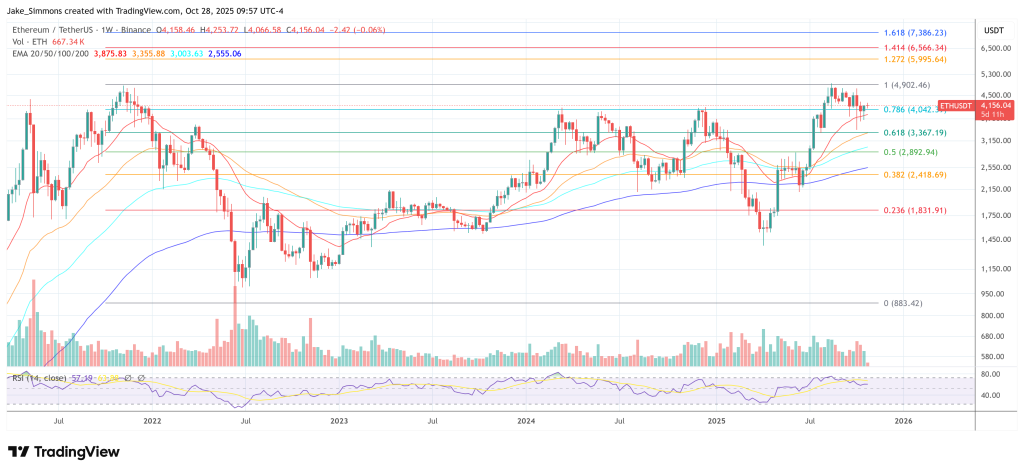
Featured picture created with DALL.E, chart from TradingView.com