

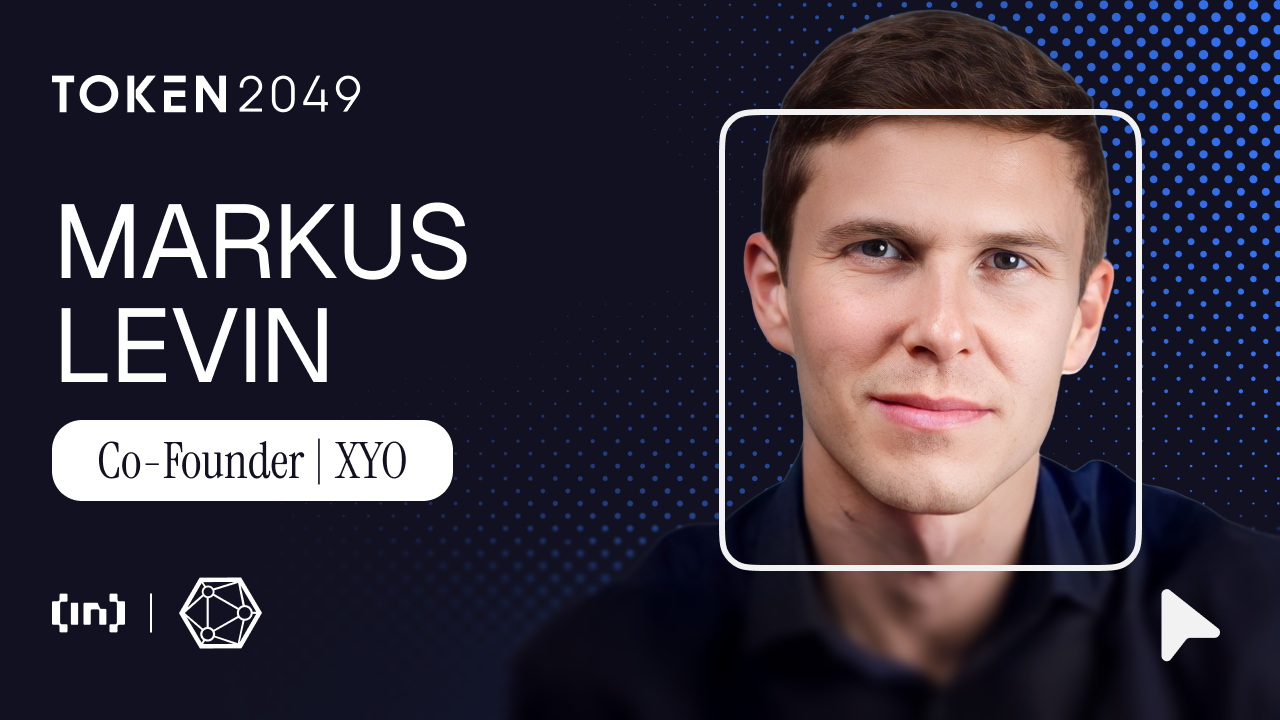
The DePIN sector is rising as blockchain’s subsequent frontier, connecting bodily infrastructure with digital networks. At Token2049 Singapore, BeInCrypto sat down with Markus Levin, Co-Founder of XYO Network. His imaginative and prescient facilities on making verifiable real-world knowledge accessible for AI and Web3 purposes.
XYO lately launched its personal XYO Layer One blockchain after seven years as a decentralized knowledge firm. With over 10 million nodes spanning practically each nation, the community tackles location verification challenges, knowledge validation bottlenecks, and prohibitive prices, amongst quite a few different knowledge processing points inherent to holder blockchains. Levin’s formidable purpose: place XYO Layer One because the definitive blockchain for AI-ready knowledge infrastructure.
XYO lately launched the XYO Layer One blockchain. After seven years in operation, what drove you to construct your personal Layer-1, and what elementary gaps within the present blockchain panorama does it deal with?
For years, XYO has operated as an information infrastructure firm within the blockchain house. Our middleware expertise linked the bodily world to digital techniques and different blockchains, offering verifiable knowledge by way of improvements like Proof of Origin and Proof of Location.
But all through that point, nobody constructed a Layer One that was really data-centric. Every main blockchain centered on transactions, shifting tokens from one pockets to one other, reasonably than constructing a basis for validated, real-world knowledge.
With the rise of AI, that hole has grow to be much more important. Reliable knowledge is now probably the most beneficial useful resource, but the infrastructure to confirm and course of it on-chain nonetheless didn’t exist. That is why we constructed XYO Layer One from the bottom up, a blockchain purpose-built for knowledge, powered by the applied sciences we have now been growing over the previous seven years.
With the rollout of the dual-token mannequin, one for governance and the opposite for utility, how do you envision the steadiness of incentives amongst node operators, builders, and enterprise purchasers in your ecosystem?
We constructed our dual-token mannequin between the XYO token, which is greater than seven years previous, and our newly launched XL1 token in a approach that they each strengthen one another—we name them yin and yang. XYO is exterior to the Layer-1. It’s for the DePIN, the ecosystem, for the rewards and contributor rewards, for staking XYO Layer One for safety, governance, and so on. It’s the governance and DePIN community token, and you may stake it in XYO Layer One to earn XL1 tokens. The XL1 token is a gasoline and transaction token for dApps inside XYO Layer One, so it’s all the time inner. You stake XYO to get XL1. Already a number of % of XYO are staked of the full provide, and we’re very excited concerning the progress we see there. That restricts the XYO provide. Then on the XL1 facet, we see tokens get burned as we have now transactions on the XYO Layer One as a result of with each transaction the gasoline charge will get burned. So principally each tokens strengthen one another.
AI, logistics, and real-time knowledge analytics industries have been highlighted as major benefactors of XYO’s expertise. Can you share examples of latest business pilots or partnerships leveraging XYO Layer One’s capabilities?
We lately introduced our partnership with an organization referred to as Piggycell from South Korea. They have 98 % share of the cellular charging market and are a Web2 firm shifting into Web3. They have charging stations in bars, eating places, and comfort shops. We are engaged on offering Proof of Location for his or her charging stations and for the customers of their gadgets, as a way to show it’s the place it’s supposed to be, and the consumer didn’t run off with the charging cable. We additionally plan to tokenize the info generated there.
How does XYO’s strategy to verifiable real-world knowledge overcome the restrictions and reliability considerations of centralized location options and different blockchain oracles?
Here’s an instance of the Pokémon Go sport. I had a number of calls with its maker, Niantic, and the issue was {that a} bunch of children sat of their basement spoofing their location and pretending to be within the Sahara to get the rarest Pokémon. This destroys the gameplay for honest gamers.
It’s only a sport, however take into consideration one thing with increased worth like automated provide chains, sensible cities, or self-driving automobiles. You need to be certain that your location can’t be spoofed or mass spoofed, and that’s what we’re right here for. We additionally do this for different DePINs. For instance, you may show that the climate station you say is in your roof is admittedly there, not someplace else. For us, it’s all about gathering and offering certainty across the knowledge so it might’t be spoofed or hacked. You can show that the info got here from the temperature sensor or a location sensor, for instance.
XYO boasts over 10 million nodes globally. What are the present priorities for increasing developer engagement and incentivizing long-term participation in your ecosystem?
We have greater than 10 million nodes in virtually each nation. We seemed into all these nodes and noticed we’re additionally in each African nation. There are about half 1,000,000 nodes in Africa now. DePIN is remodeling the world. We are motivated by gathering knowledge from underserved communities to forestall biases in AI.
For instance, we translated our web site into many languages, one in all which was Amharic, the first language of Ethiopia, with about 57 million audio system. ChatGPT made many errors with translation, and we have been curious why. That was as a result of Ethiopia is just not a precedence nation for ChatGPT—it’s not the place they earn probably the most cash. But we predict it’s essential for knowledge assortment. You want to keep away from biases in AI to make them really the voices of humanity.
We have a brand new function within the COIN App which permits you to stake your COIN—the factors you earn by utilizing the app—for XL1. We have a marketing campaign, and folks love that. When there are financial incentives, they’re enthusiastic about it. The primary staking is from XYO to the XYO Layer One to earn XL1. People see that they’ll stake within the COIN App. Then they understand they’ve XYO as a result of they redeemed their COIN factors for XYO. It’s to present them what they’ve and to get them educated.
XYO was the unique DePIN undertaking and now sits on the intersection of DePIN, DeFi, and AI. What formidable milestones or use circumstances do you intention to obtain subsequent 12 months? How will these solidify XYO’s function as knowledge infrastructure for the digital economic system?
We need to be the blockchain for AI knowledge. We are onboarding our personal DePIN community and offering extra options to allow that. Then, we onboard our third-party companions to onboard many firms into our XYO Layer One ecosystem as a result of we are able to already present our 10 million nodes and generate a lot knowledge. We are going to on board the info world into the following revolution. That’s our huge mission. It’s an thrilling time to be in DePIN. According to the World Economic Forum, DePIN will develop from about 50 million to 3.5 trillion by 2028. It’s going to be momentous.
The Road Ahead: Building the Data Economy
Blockchain is evolving past finance. XYO’s Layer-1 infrastructure represents a strategic wager on verified knowledge as the muse of the AI-driven economic system, deploying over 10 million nodes globally. The DePIN sector is projected to attain $3.5 trillion within the subsequent three years. The firm has positioned itself on the intersection of three transformative applied sciences.
The problem forward lies in changing this early-mover benefit into sustained developer adoption and enterprise partnerships. XYO’s seven-year journey has given it a head begin in a race that’s solely starting.