


Eric Conner, a outstanding Ethereum determine who helped design the community’s landmark fee-market overhaul EIP-1559 and lately left the ecosystem to work in synthetic intelligence, mentioned late Thursday that the US Securities and Exchange Commission’s new coverage path quantities to a dramatic tailwind for Ether. “The SEC just lit a rocket under Ethereum,” Conner wrote on X on July 31, reacting to a coverage tackle delivered hours earlier by SEC Chairman Paul S. Atkins in Washington. Conner characterised the remarks as a “full-blown regulatory pivot,” including that Atkins “informally but unmistakably said Ethereum is not a security,” and that the company had put ETH “in the spotlight as the foundation for the next era of US finance.”
Is Ethereum The Biggest Beneficiary Of ‘Project Crypto’?
Atkins’ ready speech, titled “American Leadership in the Digital Finance Revolution,” unveiled a program he referred to as Project Crypto—a Commission-wide effort to refit securities regulation for on-chain markets. “We are at the threshold of a new era … I am announcing the launch of ‘Project Crypto’—a Commission-wide initiative to modernize the securities rules and regulations to enable America’s financial markets to move on-chain,” he mentioned, whereas stressing that his remarks mirrored his views slightly than the Commission’s as a complete. The chair tied the initiative to a current White House-led coverage push and mentioned he had directed SEC workers to draft clear guidelines for crypto asset distributions, custody, and buying and selling, and to contemplate interpretive and exemptive aid “in the coming months” to keep away from stifling innovation.
The most consequential sign for digital-asset markets was Atkins’ stance on asset classification. “Despite what the SEC has said in the past, most crypto assets are not securities,” he mentioned, promising “bright-line rules” to assist market members decide whether or not a token needs to be handled as a digital collectible, a digital commodity, or a stablecoin, and to craft purpose-fit disclosures, exemptions and protected harbors—together with for ICOs, airdrops and community rewards. In parallel, he argued that classifying a token as a safety “should not be a scarlet letter,” and outlined a path for crypto-securities to flourish inside US markets.
Atkins additionally sketched an bold market-structure blueprint. He backed side-by-side buying and selling of non-security crypto belongings and crypto-asset securities on SEC-regulated venues, floated a “Reg Super-App” idea to let broker-dealers provide buying and selling, staking and lending underneath a single license, and mentioned he would search to modernize custody guidelines so funding advisers and broker-dealers can maintain crypto belongings underneath up to date requirements. “It will be a priority of my chairmanship to carry out the [report’s] recommendation to modernize the SEC’s custody requirements,” he famous, whereas defending customers’ proper to self-custody and staking.
Crucially for tokenization, Atkins mentioned the Commission would work with companies distributing tokenized securities within the US and supply aid the place acceptable, pointing to pent-up demand “from household names on Wall Street to unicorn tech companies” and explicitly referencing compliance-enabled token requirements resembling ERC-3643. In a bit on decentralized finance, he pledged to “create space” for each totally on-chain, non-intermediated methods and intermediated fashions, and mentioned DeFi “will be part of our securities markets.”
Why Ethereum Takes Center Stage
While Atkins’ ready remarks didn’t identify Ethereum explicitly, they repeatedly referenced Ethereum-native ideas and requirements, and out of doors the speech the chair has lately spoken extra straight about ETH. In a July 21 look on CNBC’s Squawk Box, Atkins mentioned the company has “stated informally more than formally that Ether is not a security,” including that whether or not corporates maintain ETH in treasury “is up to companies to decide.”
Conner unpacked the identical themes in an eight-part thread that ricocheted throughout Crypto-X. The former core dev argued that the speech “isn’t just lip service. It’s a full-blown regulatory pivot,” stressing that Atkins had “informally but unmistakably” eliminated the safety overhang from Ether. “That’s the clarity institutions have been waiting for,” he wrote, predicting corporate-treasury allocations and a deep link-up between DeFi and Wall Street.
He hailed the endorsement of public-chain tokenization as nonetheless extra consequential: “He said: let’s bring regulated markets on-chain… Ethereum is the obvious base layer for this.” And, in a swipe at legacy doctrine, Conner cheered the promise of purpose-built guidelines: “No more trying to jam crypto into 1940s laws.”
Whether that enthusiasm endures will rely on how rapidly Project Crypto strikes from rhetorical flourish to concrete rule-making—however, as Conner put it in his closing salvo, “ETH isn’t just a coin anymore. It’s the US government’s preferred settlement layer for modern finance. Regulatory uncertainty has been ETH’s biggest overhang, and now it’s being lifted. The SEC just put Ethereum in the spotlight as the foundation for the next era of US finance. This is bigger than an ETF. It’s regulatory alignment with ETH as the global digital asset backbone. Get ready.”
At press time, ETH traded at $3,669.
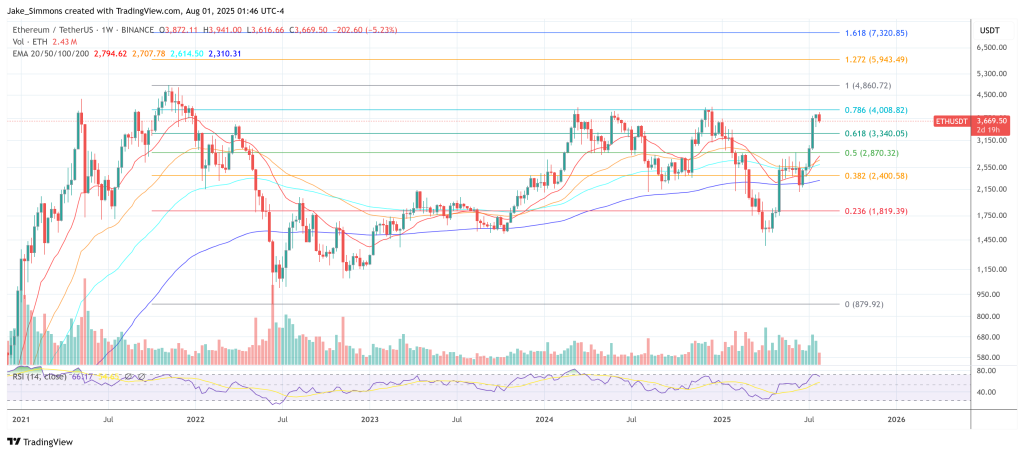
Featured picture created with DALL.E, chart from TradingView.com
Editorial Process for bitcoinist is centered on delivering completely researched, correct, and unbiased content material. We uphold strict sourcing requirements, and every web page undergoes diligent overview by our crew of prime expertise consultants and seasoned editors. This course of ensures the integrity, relevance, and worth of our content material for our readers.