


Ethereum co-founder Vitalik Buterin says the community’s clearest worth proposition will not be sensible contracts or funds, however one thing extra foundational: appearing as a censorship-resistant public information layer. In a post reflecting on conversations at Real World Crypto and associated occasions, Buterin argued that stepping outdoors “blockchain baggage” makes ETH’s core utility simpler to see.
“I was recently at Real World Crypto (that’s crypto as in cryptography) and the associated side events, and one thing that struck me was that it was a clarifying experience in terms of understanding what blockchains are for,” Buterin wrote. “We blockchain people (myself included) often have a tendency to start off from the perspective that we are Ethereum, and therefore we need to go around and find use cases for Ethereum.”
Ethereum’s Core Value Starts With A ‘Public Bulletin Board’
His level was much less about defending Ethereum as a model than re-evaluating it as infrastructure. “For a moment, let us forget that we are ‘the Ethereum community’. Rather, we are maintainers of the Ethereum tool,” he wrote, asking the place the community provides worth when seen with “zero attachment to Ethereum specifically.”
The first reply, he mentioned, is “not what you think.” It is “not smart contracts, it’s not even payments,” however what cryptographers name a “public bulletin board”, a publicly readable and writable place to put up information blobs. That issues as a result of a spread of cryptographic methods, together with safe on-line voting, software program and web site model management, and certificates revocation, rely on precisely that type of shared infrastructure.
“This does not require any computation functionality,” Buterin wrote. “In fact, it does not directly require money, though it does indirectly require money, because if you want permissionless anti-spam it has to be economic. The only thing it fundamentally requires is data availability.”
That framing leads on to Ethereum’s latest scaling work. Buterin highlighted PeerDAS, which he mentioned elevated Ethereum’s information availability capability by 2.3x, with a roadmap to push that one other 10x to 100x larger. In his telling, that makes Ethereum more and more related not only for onchain finance, however for a broader class of open, privacy-preserving web infrastructure.
Payments nonetheless matter, however as a secondary layer within the stack. Buterin argued that many methods want worth switch not primarily for commerce, however for anti-spam, sybil resistance, and machine-to-machine coordination. He pointed to Ethereum plus ZK payment channels as a robust design for permissionless APIs, and mentioned ETH can function a “natural backstop” for purposes that need to withstand fake-account abuse with out counting on cellphone numbers or different centralized id rails.
Smart contracts come after that. Here, Buterin described them as helpful for safety deposits, for implementing constructs like ZK cost channels, and for managing tips that could “digital objects” tied to socially acknowledged exterior entities. Technically, he mentioned, most non-ETH use circumstances could possibly be dealt with by treating the chain as a bulletin board and utilizing ZK-SNARKs for computation off-chain. In follow, although, standardizing that mannequin is troublesome, and shared execution stays the extra interoperable route.
The broader declare is that Ethereum works finest when understood as “global shared memory” inside a decentralized software program stack. Buterin advised adoption should lag that actuality as a result of many builders are working with outdated assumptions from 2020 to 2022, when charges had been far larger and scaling seemed much less mature. Today, he argued, charges are “extremely low,” the roadmap is stronger, and tooling to protect customers from price volatility has improved.
At press time, ETH traded at 2,110.
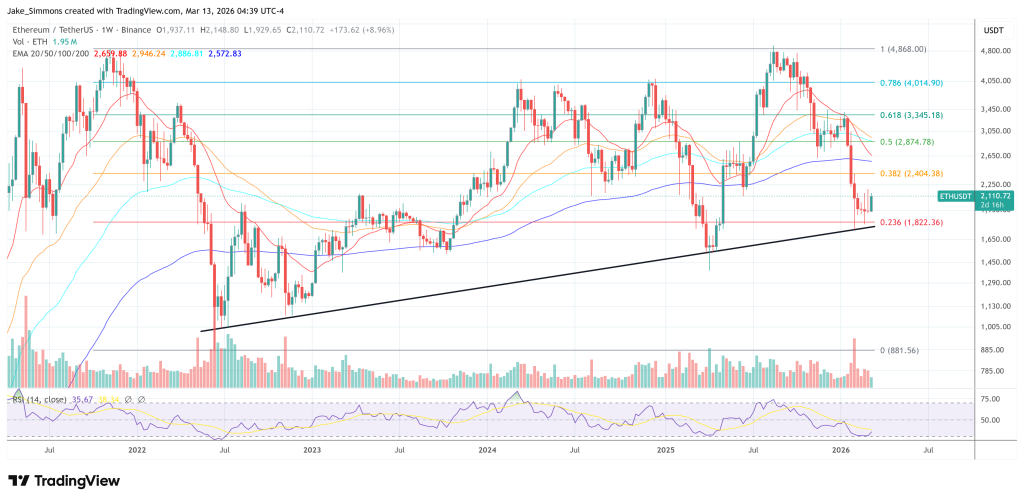
Featured picture created with DALL.E, chart from TradingView.com
Editorial Process for bitcoinist is centered on delivering totally researched, correct, and unbiased content material. We uphold strict sourcing requirements, and every web page undergoes diligent evaluation by our workforce of high know-how specialists and seasoned editors. This course of ensures the integrity, relevance, and worth of our content material for our readers.