
South Korea’s benchmark inventory index posted its steepest single-day decline on report, as geopolitical tensions from the widening US-Israel-Iran battle rattled markets.
Despite the dip in equities, merchants centered on recent crypto trade listings, with newly listed tokens posting double-digit features at the same time as broader market sentiment deteriorated sharply.
Korean Stock Market Under Pressure Amid Geopolitical Tensions
According to Google Finance knowledge, the Korea Composite Stock Price Index (KOSPI) plunged greater than 12% on Wednesday. In addition, Korea Securities Dealers Automated Quotations (KOSDAQ) noticed losses exceeding 10%.
“Seoul KOSPI officially ends down 12.06%, biggest daily percentage loss on record,” market analyst David Scutt posted.
Follow us on X to get the newest information because it occurs
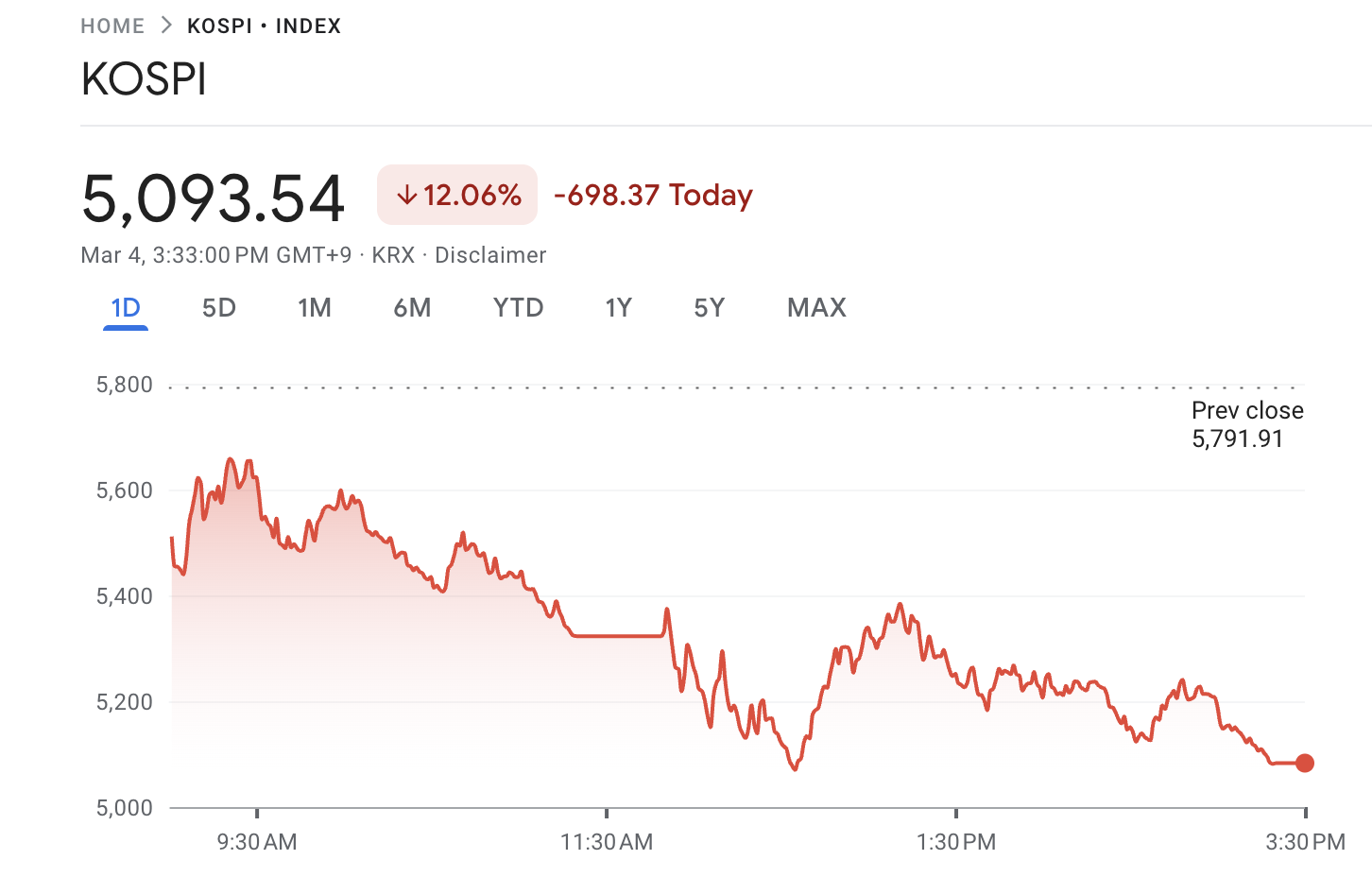
Channel News Asia reported that the Korean Stock Exchange imposed a brief buying and selling halt on Wednesday morning after each the KOSPI and KOSDAQ indices dropped by greater than 8%.
Besides South Korea, Japan, Hong Kong, and China’s inventory markets dipped on Wednesday, pushed largely by escalating world tensions. The ongoing disaster has led to a sharp spike in oil costs. Meanwhile, the closure of the Strait of Hormuz has additional heightened issues.
Asian economies are particularly susceptible to disruptions in power provides from the Middle East. Many of them rely closely on crude oil imports from Gulf states.
Japan and South Korea are significantly uncovered. 87% of Japan’s and 81% of South Korea’s complete power consumption comes from imported fossil fuels.
Why KOSPI’s Performance Matters For Crypto
The newest decline within the KOSPI follows a 7.2% drop on Tuesday, marking its worst two-day efficiency in a long time. The index is now approaching the 5,000 degree, a threshold that carries symbolic significance past being only a spherical quantity.
During this election, President Lee Jae-myung outlined his “KOSPI 5,000” imaginative and prescient and pledged to spice up the inventory market.
“I don’t think Kospi 5000 is that difficult. If you believe in me, you should take a greater interest in the stock market,” he said.
Notably, on the ultimate buying and selling day earlier than the June 3 presidential election, the KOSPI closed at 2,698.97. Over the following eight months, it surged by roughly 85%, crossing the 5,000 mark for the primary time in January 2026.
The inventory market rally had actual penalties for crypto. As equities rose, liquidity from Korean retail buyers shifted away from crypto, with many shifting their funds into shares.
BeInCrypto reported in November that crypto buying and selling volumes had dropped by over 80%. Moreover, based on the Bank of Korea’s Financial Stability Report, the turnover in Korea’s crypto market reached 157%, compared to the global figure of 112%, as retail buyers more and more sought short-term income.
Crypto Listings Defy Broader Market Turmoil
This drop in equities sharply contrasts with developments in South Korea’s digital asset sector. While shares fell, new altcoins on South Korean exchanges noticed robust demand.
CoinGecko highlighted that Definitive Finance’s EDGE token posted strong gains after its Upbit itemizing.
Furthermore, Centrifuge’s CFG token rallied 21.6% following its itemizing on Bithumb. The efficiency of those tokens suggests South Korean crypto buyers should still have an urge for food for digital property, even when conventional markets undergo.
However, it stays unclear if this enthusiasm is sustainable. Exchange listings typically drive preliminary pleasure and quantity that may inflate costs, no matter broader market sentiment.
The foremost query is whether or not these features replicate a real shift from shares to crypto, or in the event that they’re merely pushed by short-term hypothesis. Moreover, if the KOSPI selloff deepens and Korean retail sentiment turns decisively damaging, capital that had rotated into equities could not mechanically return to crypto. A sustained risk-off temper may suppress inflows throughout each asset lessons.