
Strategy government chairman Michael Saylor has affirmed that the agency won’t cease shopping for Bitcoin regardless of the prevailing volatility and unrealized losses on the corporate’s funding. He dismissed arguments that declining costs will pressure the corporate to liquidate its holdings.
Michael Saylor Affirms Strategy Will Not Sell
In an interview with CNBC, the Strategy co-founder stated they won’t promote their BTC holdings, regardless of hypothesis that market circumstances could pressure the corporate to take action. He famous that Strategy considers its Bitcoin buy as a long-term determination and never a short-term one.
Michael Saylor maintained that the credit score danger related to Strategy may be very low, even in excessive circumstances. Instead, he claimed that Bitcoin would wish to drop about 90% and stay down for years earlier than refinancing would turn out to be difficult. He insisted that, in such a case, the corporate would nonetheless have the ability to roll ahead its debt obligations. This echoes Strategy CEO Phong Le’s recent statement that Bitcoin must drop to $8,000 and stay there by 2032 for them to face liquidation dangers.
Meanwhile, the Strategy co-founder famous that his firm owns a long time of dividends in Bitcoin. This large reserve will give it an ideal monetary buffer. With this, he feels that there is no such thing as a trigger to fret about pressured liquidation as being exaggerated by short-term merchants.
Michael Saylor additionally addressed hypothesis about Strategy’s monetary state of affairs. He claimed that the corporate has two and a half years of money reserves to make dividend and debt funds. He added that the web leverage ratio of Strategy is one-half of a mean investment-grade firm.
Strategy Will Keep Buying Bitcoin
The government chairman additionally clarified that Strategy’s Bitcoin accumulation plans haven’t modified. He stated the corporate has raised billions in capital to additional accumulate Bitcoin. “We’re not going to be promoting. We are going to be shopping for bitcoin, Michael Saylor stated.
He additional indicated that Strategy will purchase Bitcoin every quarter going ahead. On Monday, Strategy declared another weekly Bitcoin buy of 1,142 BTC between February 2 and eight. According to Saylor, volatility is a attribute of the asset. Also, he remarked that Bitcoin offers two to a few occasions higher returns than conventional belongings like gold, equities, and actual property over a multi-year timeframe.
The firm’s dedication to maintain shopping for extra Bitcoin although it’s dealing with an unrealized lack of $5.1 billion on its BTC holdings. This follows BTC’s crash under Strategy’s common purchase value of $76,056 for its Bitcoin funding.
Saylor Comments On Market Volatility
Michael Saylor additionally defined {that a} current volatility within the shares of Strategy was a results of a market pullback of Bitcoin. The Strategy co-founder stated the final 4 months had been an unprecedented drawdown for MSTR inventory, however famous that it not too long ago posted a 25% acquire in a day.
He argued that Strategy’s stock is extra liquid on a market cap foundation than any of the Mag 7 shares by 2.34 occasions. He additionally indicated that open curiosity in MSTR choices is presently the very best when put next with different prime U.S. equities.
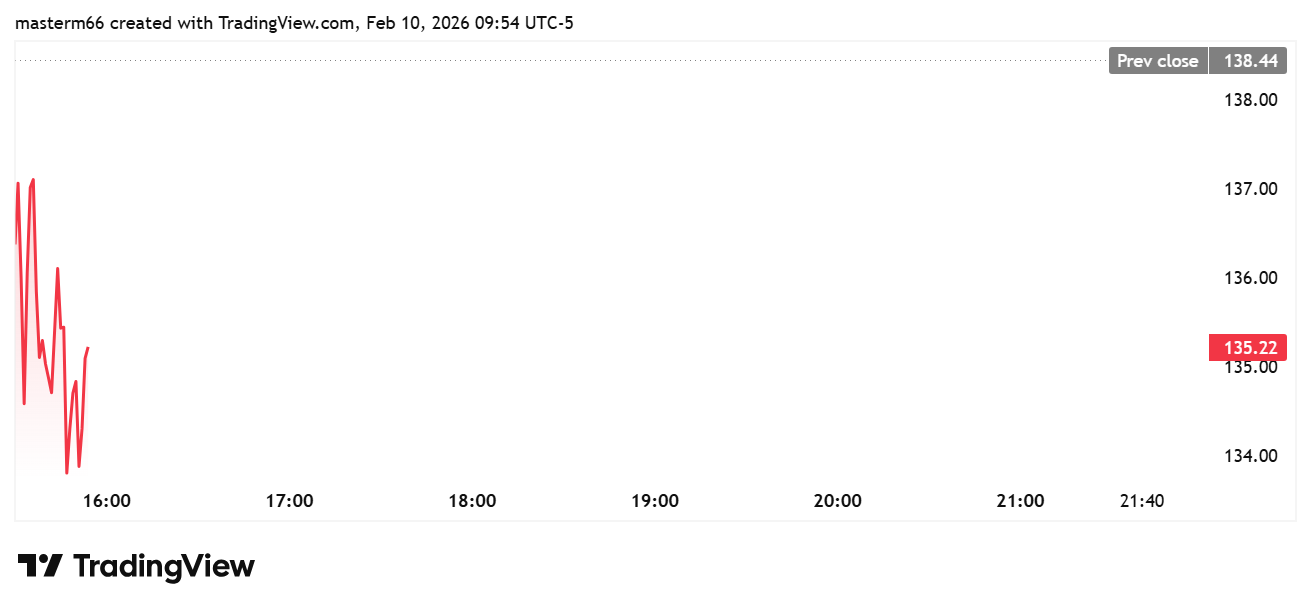
There can be ongoing draw back momentum within the firm’s inventory because of the crash in BTC. MSTR inventory has dropped to $134.93, down 2.38% during the last day, based on TradingView information.
Another level raised throughout the interview was that Bitcoin has a structural ground value of about $60,000 as a result of the price of manufacturing for miners. Michael Saylor downplayed this argument. He stated that growing the presence of huge banks and institutional credit score markets will trigger a way more important impression on the motion of BTC’s value.
Saylor refused to offer a 12-month prediction on the worth of Bitcoin. Instead, he predicts that Bitcoin would carry out two to a few occasions higher in comparison with the S&P 500 within the subsequent 4 to eight years.